Sarajevo Travel Guide — The city where four centuries of civilization exist in just two hundred meters
⏱ 11 min read📅 Updated 2026💶 € Budget✈️ Best: Apr–Sep
€25–45/day
Daily budget
Apr–Sep
Best time
3–5 days
Ideal stay
BAM (KM)
Currency
Stand at the corner of Baščaršija's cobbled lanes and you can smell roasting coffee and grilling ćevapi before you even lift your eyes to the copper-domed mosques overhead. Sarajevo is a city that assaults the senses gently — the morning call to prayer drifts across rooftops just as Orthodox church bells begin to ring, and the scent of freshly baked somun bread mingles with the diesel warmth of trams rattling past Austro-Hungarian facades. Few cities on Earth compress so many competing histories, architectural styles, and culinary traditions into such a walkable, intimate core. Sarajevo earned the nickname 'Jerusalem of Europe' centuries ago, and it still wears the title honestly, its mosques, synagogues, Orthodox and Catholic churches clustered within minutes of one another on streets that slope gently toward the Miljacka River.
Visiting Sarajevo today means confronting a city in confident, creative recovery — one that has transformed three decades of post-war rebuilding into a genuine cultural renaissance. Unlike Prague or Dubrovnik, where overtourism has hollowed out authenticity, things to do in Sarajevo still feel lived-in and genuinely local: a burek bakery that has been open since 4 a.m. for shift workers, a jazz bar in a former ammunition tunnel, a film festival that draws directors from sixty countries each August. Sarajevo rewards the curious traveler who is willing to walk a little further and ask a few questions, because behind every renovated facade is a family story that spans empires, wars, and extraordinary resilience. This destination punches far above its weight for culture, gastronomy, and sheer human warmth.
✦ Find your perfect destination
Is Sarajevo really your perfect match?
Answer 12 quick questions about your travel style, budget and dates — we match you with the destinations that fit you best, from 600+ worldwide.
Sarajevo belongs on every serious traveler's list for one simple reason: nowhere else on the continent can you walk from a functioning 16th-century Ottoman bazaar through a Sephardic Jewish quarter, past a Hapsburg opera house, and into a cutting-edge contemporary art museum within twenty minutes on foot. Sarajevo's density of experience is extraordinary — history here is not curated behind glass but lived daily, in market stalls, family-run meyhanes, and hillside cemeteries that double as city viewpoints. Add to this a food scene built on wood-fired grills and slow-simmered Bosnian pots, mountain hiking within thirty minutes of the center, and some of the most affordable prices in Europe, and Sarajevo becomes genuinely irresistible.
The case for going now: Sarajevo's moment is now: the city is experiencing a wave of boutique hotel openings, specialty coffee roasters, and design-led restaurants that have made it a fixture on every 'emerging destination' list without yet inflating prices. Budget travelers still eat a full three-course meal for under ten euros, and the 2026 anniversary of the city's 1984 Winter Olympics is prompting new investment in mountain infrastructure on Bjelašnica and Jahorina. Fly while the crowds are light and the locals still outnumber the tourists in Baščaršija on a Wednesday afternoon.
🕌
Ottoman Bazaar Walk
Wander Baščaršija's covered market lanes, ducking into copper workshops and hand-painted tile shops that have occupied the same stalls since the 1460s. The sensory layering is unlike anywhere else in Europe.
🏔️
Olympic Mountain Day
Take a twenty-minute drive to Bjelašnica or Trebević and hike trails that hosted the 1984 Winter Olympics, passing abandoned bobsled runs now colonized by street murals and wildflowers.
🎬
Sarajevo Film Festival
In August, the city transforms into the Cannes of the Balkans — open-air screenings in the old town, industry parties in converted warehouses, and free outdoor showings on Raiva Square.
🕍
Multi-Faith Quarter
Walk the legendary 200-meter stretch where the Gazi Husrev-beg Mosque, the Old Orthodox Church, the Catholic Cathedral, and the Ashkenazi Synagogue all stand within earshot of one another.
Sarajevo's neighbourhoods — where to focus
Ottoman Heart
Baščaršija
The old bazaar district is Sarajevo's beating, copper-scented heart. Built in the 15th century under Ottoman rule, its pedestrianized lanes are lined with hans (caravanserais), artisan workshops, and the city's oldest coffee houses. Baščaršija is where you eat your first ćevapi, watch coppersmiths hammer trays by hand, and understand why Sarajevo feels unlike any other European city.
Hapsburg Boulevard
Ferhadija–Austro-Hungarian Quarter
Step west from Baščaršija and the architecture shifts abruptly into grand Hapsburg eclecticism — wide boulevards, wrought-iron balconies, and the ornate yellow facade of the City Hall. This is Sarajevo's café and gallery district, home to independent bookshops and the city's main shopping promenade, where locals stroll in the early evening for their daily korzo.
Bohemian Village
Kovači & Bistrik
Climb the steep lanes above Baščaršija into the hillside mahala neighborhoods of Kovači and Bistrik and Sarajevo reveals its most intimate face. Wooden Ottoman houses with jutting upper floors overlook walled gardens, and the old Islamic cemetery at Kovači holds the tomb of wartime President Izetbegović. The views back over the city's minarets and red-tiled rooftops are the finest in town.
New City Energy
Grbavica & Marijin Dvor
Across the Miljacka River, Marijin Dvor is Sarajevo's modernist district — home to the National Museum, the History Museum, and the sleek glass Holiday Inn that became famous as the journalists' bunker during the 1990s siege. Grbavica, just beyond, is where young Sarajevans congregate in craft-beer bars and record shops, offering a grittier, more contemporary city experience.
Top things to do in Sarajevo
1. #1 Explore Baščaršija on Foot
No Sarajevo itinerary is complete without spending at least half a day lost in the lanes of Baščaršija, the Ottoman bazaar at the city's eastern core. Founded in 1462 by Gazi Husrev-beg, the market is organized into craft guilds — you will find entire streets devoted to coppersmiths, another to jewelers, another to leather workers — a medieval urban logic that still functions. Begin at the Sebilj fountain, the city's beloved wooden kiosk that appears on every postcard, and let the lanes unspool organically. Duck into the Brusa Bezistan, a 16th-century covered bazaar selling textiles and souvenirs, and pause at the Gazi Husrev-beg Mosque for one of the finest examples of Ottoman religious architecture outside Turkey. The whole experience costs nothing but time and is best done on a weekday morning when the light falls low through the copper shop awnings.
2. #2 Visit the War Tunnel & Siege Sites
Understanding Sarajevo today requires grappling with the 1,425-day siege of 1992–1995, the longest siege of a capital city in modern warfare history. The Tunnel of Hope — a 800-meter passage dug by hand beneath the airport runway to smuggle food, weapons, and people into the blockaded city — is now a moving museum in the suburb of Butmir, about twenty minutes from the center by taxi. The original family home above the tunnel entrance remains the exhibition space, and descendants of the family that operated it often act as guides. Back in the city, the Sarajevo War Tunnel Museum complements a walk along Sniper Alley (now called Zmaja od Bosne boulevard) and the sobering rows of red-chair memorials placed annually in April on the city's main street, one for each civilian killed.
3. #3 Hike Trebević Mountain
One of the best things to do in Sarajevo is to escape it momentarily by taking the revived Trebević cable car from the old town up to the mountain that looms over the city's southern edge. Reopened in 2018 after sitting dormant since the war, the gondola deposits you in a landscape of pine forest and panoramic city views in under ten minutes. From the top, a well-marked trail leads to the abandoned 1984 Olympic bobsled and luge track, whose concrete half-pipes are now spectacularly covered in murals by artists from across the former Yugoslavia — one of the most visually striking pieces of unintentional outdoor art in Europe. Bring a picnic, pack a jacket even in summer, and allow two to three hours for the full loop back down through the forest to the Bistrik neighborhood.
4. #4 Discover the National Museum & Yellow Fortress
Sarajevo's Zemaljski muzej (National Museum of Bosnia and Herzegovina) is one of the oldest and most important museums in the Western Balkans, housing the extraordinary Sarajevo Haggadah — a 14th-century illuminated Jewish manuscript that survived the Inquisition, two World Wars, and the 1990s siege, often hidden by a Muslim curator. The museum's natural history and archaeology collections are equally impressive, set in a beautiful late-19th-century building with a courtyard botanical garden. After the museum, walk fifteen minutes uphill to the Yellow Fortress (Žuta Tabija), a ruined Ottoman fortification above Baščaršija where locals gather every evening at sunset with beers and blankets for the city's most democratic viewpoint — no entry fee, no tourism infrastructure, just Sarajevo at its most unguarded and lovely.
What to eat in Bosnia and Herzegovina — the essential list
Ćevapi
Sarajevo's signature dish: small, skinless grilled sausages of minced beef and lamb, served in a pillowy somun flatbread with raw onion and thick kajmak cream. Order the ten-piece portion at any Baščaršija ćevabdžinica for the definitive version.
Burek
Flaky filo pastry coiled into a spiral and filled with seasoned minced meat, then baked in a stone-lined oven. In Sarajevo, burek refers specifically to the meat version — locals eat it for breakfast with a glass of cold yogurt and consider the debate over the best bakery a serious civic matter.
Bosanski Lonac
Bosnia's great slow-cooked stew, layers of beef, lamb, and root vegetables sealed in a clay pot and left to braise for hours over low heat. The result is deeply savory and warming — a dish that speaks to the Ottoman culinary heritage of long-fire cooking and generous portions.
Tufahija
A poached whole apple stuffed with crushed walnuts and sugar, topped with whipped cream. This Ottoman-era dessert is Sarajevo's most elegant sweet, served chilled in glass dishes at traditional Bosnian restaurants and deceptively simple in its floral, syrupy depth.
Bosnian Coffee
Served in a small copper džezva pot alongside a cube of sugar, a glass of water, and a piece of rahat lokum, Bosnian coffee is a social ritual as much as a drink. Never stirred — you pour slowly and let the grounds settle — and never rushed. Allow at least twenty minutes.
Klepe
Sarajevo's answer to ravioli: small handmade dumplings filled with seasoned minced meat, boiled and then draped with a sauce of sautéed garlic in butter and topped with kaymak or sour cream. A staple of home kitchens and a growing fixture on refined Bosnian restaurant menus.
Where to eat in Sarajevo — our top 4 picks
Fine Dining
Park Prinčeva
📍 Iza Hrida 7, Sarajevo
Perched high above the city in a terrace restaurant with arguably the finest panorama in Sarajevo, Park Prinčeva offers refined Bosnian cuisine with a contemporary touch — expect elegantly plated grilled meats, seasonal vegetable dishes, and a wine list that champions Herzegovinian Žilavka and Blatina varietals. Reserve a window table at sunset.
Fancy & Photogenic
Inat Kuća (Spite House)
📍 Velika Alifakovac 1, Sarajevo
One of Sarajevo's most storied dining rooms occupies a 19th-century Ottoman house that was literally moved stone by stone across the Miljacka River when the Hapsburgs built City Hall — the owner refused to sell. Today it serves traditional Bosnian dishes beneath low wooden beams and embroidered cushions, with the river and Latin Bridge visible from almost every table.
Good & Authentic
Ćevabdžinica Hodžić
📍 Bravadžiluk 34, Sarajevo
The Hodžić family has been grilling ćevapi on Bravadžiluk street for decades, and the regulars who queue here at lunchtime are a reliable measure of quality. Charcoal-grilled and served the old way, on an unlined plate with a mountain of onions and a basket of warm somun — no frills, no menus, no decisions beyond how many pieces.
The Unexpected
Dveri
📍 Prote Bakovića 12, Sarajevo
Tucked into an old town courtyard, Dveri serves creative farm-to-table Bosnian cooking that surprises visitors expecting only grilled meat — think slow-braised lamb shoulder with foraged herb sauces, nettle soups, and artisanal cheese plates sourced from mountain producers in central Bosnia. The courtyard seating under strings of bulb lights is enchanting on summer evenings.
Sarajevo's Café Culture — top 3 cafés
The Institution
Café Tito
📍 Zmaja od Bosne 8, Sarajevo
Named for Yugoslavia's famous president and filled with retro Yugoslav memorabilia, Café Tito is a beloved local institution opposite the old Yugoslav-era buildings in Marijin Dvor. The coffee is strong, the seating mismatched and charming, and the clientele a generous cross-section of Sarajevo's intellectuals, students, and nostalgic older generation who remember the city before the war.
The Aesthetic Hub
Zlatna Ribica
📍 Kušlanova 14, Sarajevo
This eccentric, collector's-den café is crammed floor-to-ceiling with antiques, Communist-era tchotchkes, old photographs, and a bar built from repurposed furniture — it looks like the world's most charismatic attic. Sarajevans bring first dates here, knowing the interior alone will sustain conversation for the entire evening. The cocktails are inventive, the Bosnian coffee is excellent.
The Local Hangout
Čajdžinica Džirlo
📍 Kovači 16, Sarajevo
Hidden on the steep Kovači lane above Baščaršija, this tiny teahouse has served herbal teas and Bosnian coffee to hillside residents and knowing visitors for generations. Low wooden seats, embroidered cushions, and the smell of dried chamomile and mountain mint create an atmosphere of profound calm. It is the perfect stop mid-climb before continuing up to the Yellow Fortress viewpoint.
Best time to visit Sarajevo
Jan
Feb
Mar
Apr
May
Jun
Jul
Aug
Sep
Oct
Nov
Dec
Peak Season (Apr–Sep) — warm days, festival calendar, outdoor cafés in full swingShoulder Season (Mar & Oct) — mild, fewer crowds, great value on accommodationOff Season (Nov–Feb) — cold and sometimes snowy, but atmospheric and very cheap; ski season on nearby mountains
Sarajevo events & festivals 2026
Whether you're planning around a specific celebration or simply want to know what's happening, this guide covers the best events and festivals in Sarajevo — from major annual traditions to cultural highlights worth timing your trip around.
August 2026culture
Sarajevo Film Festival
Now in its fourth decade, the Sarajevo Film Festival is the largest and most prestigious film event in Southeast Europe, drawing directors, actors, and industry figures from over sixty countries. Open-air screenings in Baščaršija and indoor premieres at the National
April 2026culture
Sarajevo Spring of Culture
An annual multi-arts festival welcoming spring with theatre performances, classical concerts, contemporary dance, and visual art exhibitions staged across the city's historic venues. The festival draws touring companies from across Europe and marks the opening of Sarajevo's outdoor cultural season with events often free to attend.
July 2026music
Jazz Fest Sarajevo
One of the region's finest jazz festivals, staged annually in the old town with headline concerts in the courtyard of the National Theatre and smaller club performances in Baščaršija's converted hans. International and Balkan jazz artists share billing, and the intimate venues create an atmosphere that large arena festivals cannot replicate.
October 2026culture
MESS International Theatre Festival
MESS is one of Europe's oldest and most respected international theatre festivals, held annually in Sarajevo since 1960. Companies from across Europe, Asia, and the Americas perform experimental and contemporary productions in theatres and unconventional spaces around the city — an essential fixture for culture travelers visiting Sarajevo in autumn.
December 2026market
Sarajevo Winter Festival
From late November through January, Sarajevo's old town and Ferhadija promenade transform into a winter market with handmade craft stalls, mulled wine, roasted chestnuts, and a program of concerts and cultural events. The Ottoman and Hapsburg backdrop makes the decorations feel genuinely magical rather than generic.
June 2026music
Baščaršija Nights
Every evening throughout June and July, the squares and open spaces of Baščaršija host free or low-cost concerts spanning sevdalinka traditional music, folk ensembles, classical recitals, and contemporary acts.
May 2026culture
Sarajevo War Theatre Festival
An annual festival commemorating the role of Sarajevo's theatres during the 1992–1995 siege, when companies performed throughout the war. Contemporary productions explore themes of resistance, memory, and identity, staged in the historic venues that kept performing under bombardment — a moving and uniquely Sarajevan cultural experience.
March 2026religious
Nowruz (Persian New Year Celebrations)
Sarajevo's Bektashi and Sufi communities mark the Persian New Year with public celebrations centered on Baščaršija, including music, shared meals, and ceremonial gatherings. The event reflects the city's deep Ottoman heritage and offers visitors a rare window into Bosnia's living Islamic mystical traditions.
September 2026culture
Sarajevo Design Week
A growing international design and architecture festival that has established Sarajevo as a creative hub in the Western Balkans. Exhibitions, workshops, and public installations are staged across the city, with particular focus on the intersection of design and post-conflict urban recovery — a field in which Sarajevo has significant and hard-won expertise.
November 2026culture
BH Film Festival
The national Bosnian and Herzegovinian film festival showcasing the best of domestic film production alongside a strong regional program. Held in Sarajevo cinemas each November, it is a vital gathering point for the local film industry and offers visitors an opportunity to see Balkan cinema that rarely reaches Western European screens.
Hostel dorm or guesthouse, burek breakfast, ćevapi lunch, self-catering or cheap local restaurant, tram transport.
€€ Mid-range
€35–65/day
Boutique hotel, sit-down meals at Dveri or Inat Kuća, museum entries, cable car, occasional taxi.
€€€ Luxury
€65+/day
Design hotel suite, Park Prinčeva dinners, private guided tours, day-trip hire car, spa treatments at Ilidža.
Getting to and around Sarajevo (Transport Tips)
By air: Sarajevo International Airport (SJJ) receives direct flights from London Heathrow, Vienna, Istanbul, Amsterdam, Zürich, and several other European hubs. Austrian Airlines, Turkish Airlines, Lufthansa, Wizz Air, and FlyBosnia all serve the city. Flight time from London is approximately two and a half hours; from Amsterdam or Frankfurt, under two hours.
From the airport: The airport sits just seven kilometers southwest of Baščaršija. A taxi to the city center costs approximately 15–20 BAM (around €8–10) and takes fifteen to twenty minutes in normal traffic. Agree the fare before departure or insist the meter is running. There is no direct airport rail link, but public bus line 36 connects to Ilidža tram terminus for those on a tight budget.
Getting around the city: Sarajevo's city center is almost entirely walkable — Baščaršija to Marijin Dvor is a twenty-minute stroll along the Miljacka River. The historic electric tram network (one of the oldest in Europe, dating to 1885) runs east–west along the main boulevard and costs under one euro per ride with a purchased card. Taxis are metered and inexpensive by Western European standards; use licensed yellow cabs or the local app Car:Go.
Transport Safety & Scam Prevention:
Taxi Overcharging: Unlicensed taxis waiting outside the airport and outside Baščaršija restaurants sometimes quote flat rates three to five times higher than metered fares. Always insist on the meter or use the Car:Go app to lock in a price before you get in.
Currency Exchange Rates: Exchange booths in the tourist area of Baščaršija occasionally display misleading rates with a small buy/sell spread printed in large type while unfavorable commission charges appear only in small print. Use bank ATMs for the best conversion rates and always check your receipt.
Souvenir Pricing in the Bazaar: Handmade copper and silver items in Baščaršija are genuinely artisan-made and worth buying — but the first price quoted to obvious tourists can be inflated by 30–50%. A friendly, polite counter-offer is entirely normal and expected; the craftspeople are accustomed to negotiating and rarely take offence.
Do I need a visa for Sarajevo?
Visa requirements for Sarajevo depend on your nationality. Select your passport below for an instant answer — based on the Passport Index dataset for entry into Bosnia and Herzegovina.
ℹ️ Indicative only. Always verify with the official consulate before booking. Data: Passport Index, April 2026.
For detailed requirements, documentation checklists and processing times by nationality: TravelDoc →
Search & Book your trip to Sarajevo
Find the best flight routes and hotel combinations using our partner Kiwi.com.
Frequently Asked Questions
Is Sarajevo safe for tourists?
Sarajevo is genuinely safe for tourists by any reasonable measure. Petty crime — bag snatching, pickpocketing — is rare compared to Western European capital cities, and violent crime against visitors is extremely uncommon. The city center, including Baščaršija and the Austro-Hungarian quarter, is well-lit and busy until late at night. Solo female travelers report feeling comfortable walking the old town in the evening. As in any city, common-sense precautions apply: keep an eye on your belongings in crowded markets and avoid poorly lit peripheral neighborhoods late at night.
Can I drink the tap water in Sarajevo?
Yes — Sarajevo tap water is safe to drink and is, by most accounts, among the freshest and cleanest in the Balkans, sourced from the karst springs of the Dinaric Alps that feed the Bosna River. Locals drink it without hesitation and many restaurants will bring a jug of tap water on request. Bottled water is widely available if you prefer it, but there is no health reason to avoid the tap in normal circumstances.
What is the best time to visit Sarajevo?
The best time to visit Sarajevo is from April through September, when days are warm and sunny, the old town's outdoor cafés are in full swing, and the city's rich calendar of events — including the Sarajevo Film Festival in August and Baščaršija Nights in June and July — is at its peak. May and June offer the ideal balance of pleasant temperatures, smaller crowds, and lower accommodation prices than high summer. October is a lovely shoulder month with autumn foliage on the surrounding hills. Winter brings a magical quiet and occasional snow, plus skiing on nearby Bjelašnica and Jahorina.
How many days do you need in Sarajevo?
Three days is enough to experience Sarajevo's essential character — the Ottoman bazaar, the Hapsburg boulevard, the multi-faith quarter, the Tunnel of Hope museum, and an evening on the Yellow Fortress viewpoint. Four to five days allows you to add a day trip to Mostar, a hike on Trebević mountain, and a deeper dive into the National Museum. A week or more is rewarding for those who want to explore the surrounding mountain villages, attend a festival, or take the bus south to the dramatic landscapes of the Neretva valley. Sarajevo is compact but surprisingly dense — you will not exhaust it in three days.
Sarajevo vs Mostar — which should you choose?
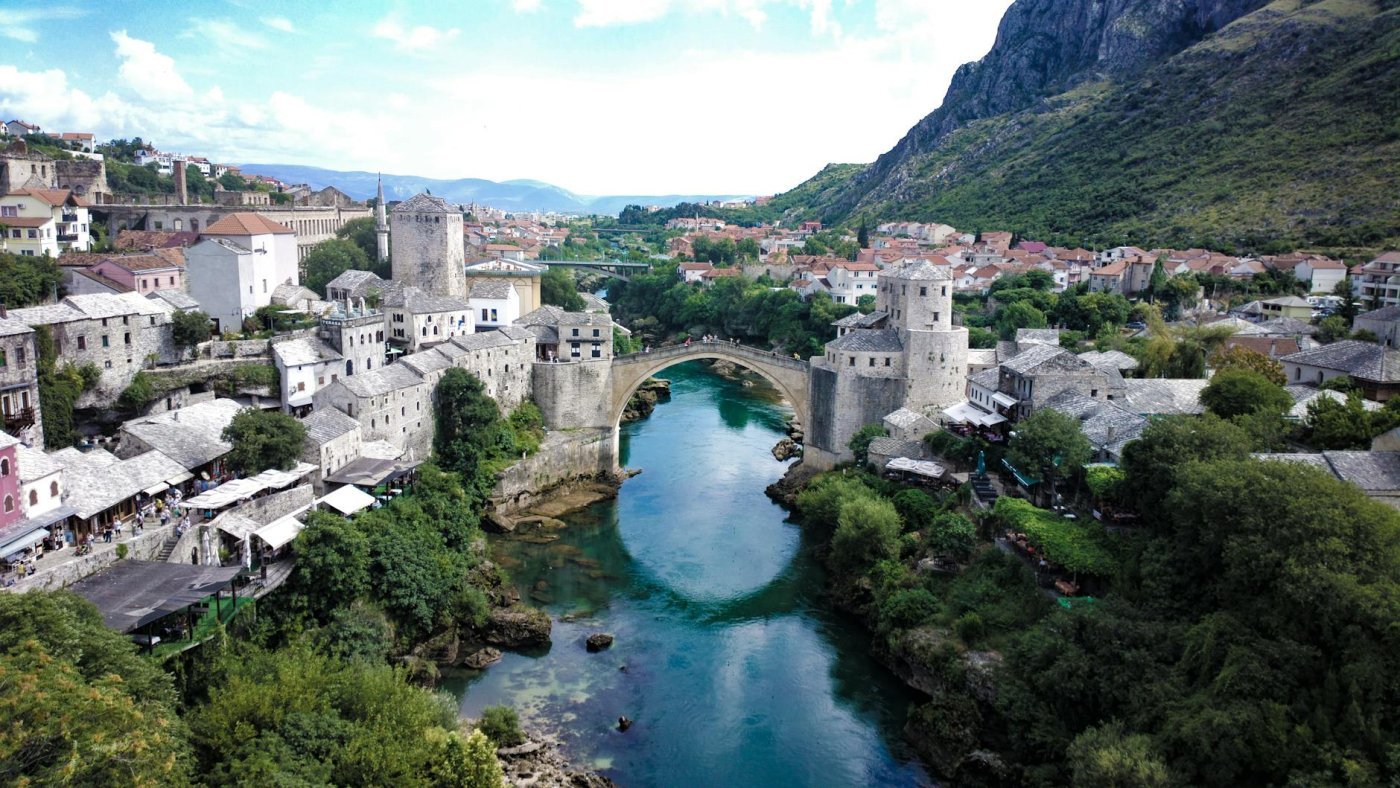
Sarajevo and Mostar are complementary rather than competitive — most visitors to Bosnia should try to see both. Mostar offers a single iconic image: the reconstructed Stari Most bridge above a turquoise river gorge, surrounded by a charming but increasingly tourist-saturated old town. Sarajevo is layered, complex, and less immediately photogenic but far richer in museums, food culture, nightlife, and living urban energy. If you only have time for one, choose Sarajevo — it rewards longer stays and has far more depth. If you have five days or more, do both: the two-hour bus south to Mostar makes for a perfect day trip from your Sarajevo base.
Do people speak English in Sarajevo?
English is spoken well in Sarajevo, particularly among younger Bosnians, hotel staff, restaurant workers, and anyone in the tourism sector. University students often speak excellent English alongside German or Turkish. Older generations may speak German or French more readily than English — a legacy of guest-worker migration patterns during the Yugoslav era. In Baščaršija's artisan workshops and local markets, basic phrases in Bosnian are warmly appreciated even if unnecessary. Overall, navigating Sarajevo as an English-speaking visitor is easy, and you will rarely need to resort to a translation app.
★ Hotel guide
Where to stay in Sarajevo
7+ hand-picked hotels across luxury, mid-range and budget — verified by Max.
Hand-picked and verified by Max, who founded Vacanexus from Luxembourg in 2026. No sponsorships, no paid placements. Every recommendation — restaurants, neighbourhoods, things to do — is selected for authenticity over popularity.